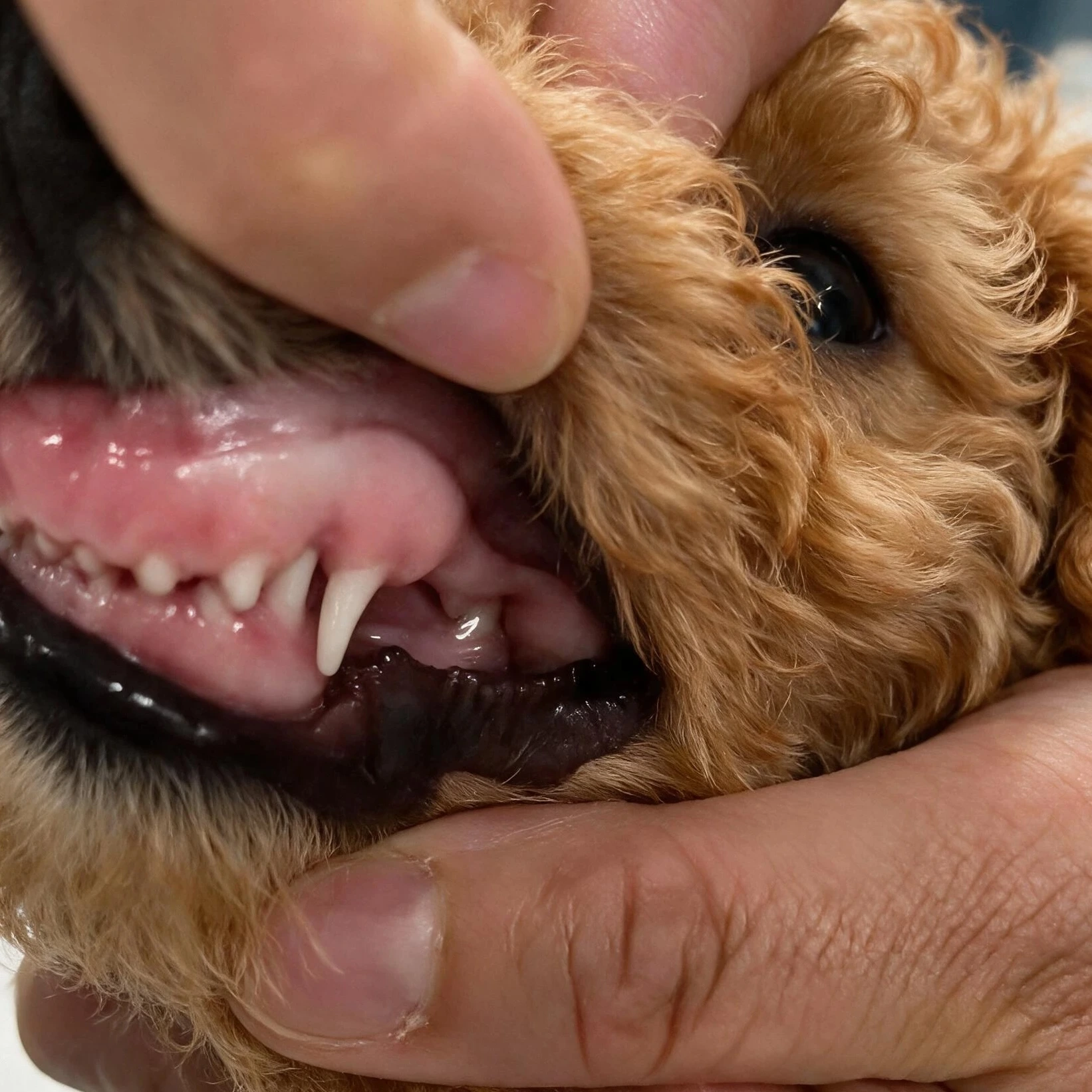

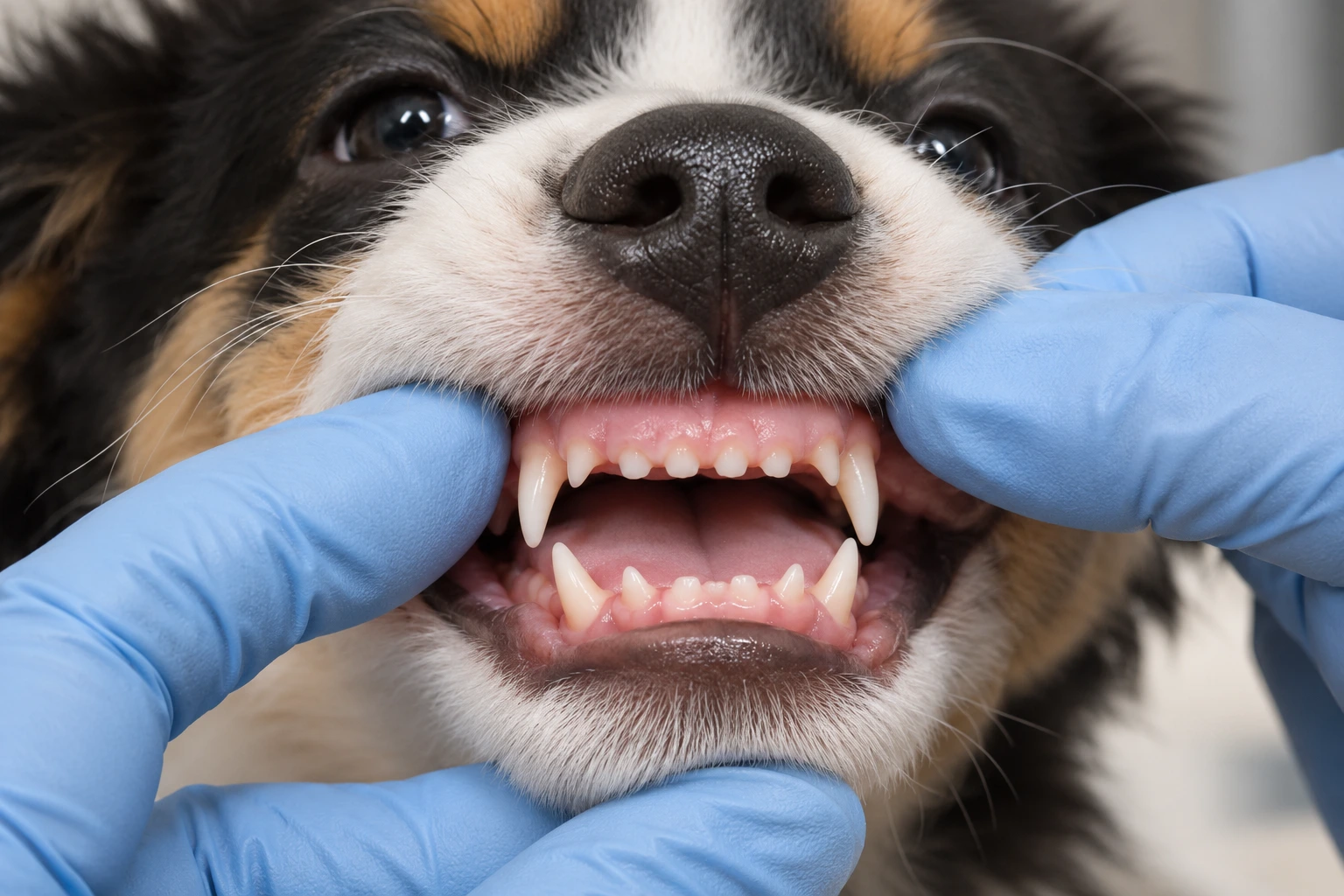
Puppies go through quite a few dental changes in their first six months. Most happen without any problems, but occasionally a baby tooth doesn’t fall out when it should, or an adult canine tooth starts growing in the wrong direction.
These problems are worth identifying early. A puppy can have a tooth pressing into the roof of its mouth and still be eating, playing and behaving normally. By the time the problem becomes obvious, there may already be damage to the surrounding tissues.
The important thing isn’t whether your puppy’s teeth look perfectly straight. It’s whether the teeth are developing normally, whether the upper and lower jaws fit together comfortably, and whether any teeth are contacting tissues they shouldn’t.
How puppy canine teeth normally develop
Dogs have two sets of teeth. The first are the deciduous teeth, commonly called baby or milk teeth. These are gradually replaced by the permanent adult teeth as the puppy grows.
Puppies have 28 deciduous teeth and, once fully developed, most adult dogs have 42 permanent teeth. The canine teeth are the four pointed teeth near the front of the mouth, one on each side of the upper and lower jaws.
Puppy tooth development timeline
Age | Expected development |
|---|---|
3–6 weeks | Deciduous canine teeth usually erupt |
3–4 months | Permanent incisors begin replacing baby incisors |
4–6 months | Deciduous canine teeth are generally shed as permanent canines erupt |
5–7 months | Most permanent teeth complete eruption |
These are approximate ages, not strict deadlines. Breed, size and individual development can influence the timing.
During teething, owners may notice increased chewing, occasional mild gum irritation or a small amount of blood on a chew toy. Some puppies swallow their baby teeth, so owners may never actually find one.
What matters more than the precise date is how the permanent teeth are emerging and whether the deciduous teeth are making way for them.
Why does my puppy have two canine teeth?
One of the more common dental abnormalities in young dogs is a persistent deciduous canine tooth.
This happens when the baby canine tooth remains in place as the permanent canine erupts alongside it. Instead of one canine tooth, there appear to be two sitting close together.
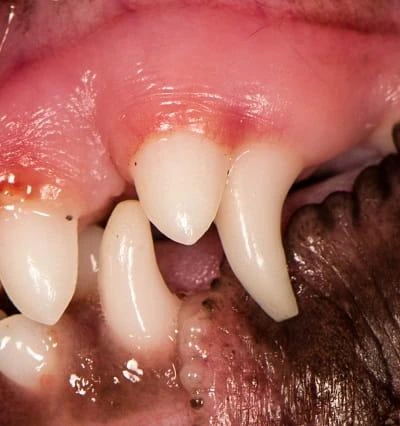
A retained baby tooth can interfere with the normal eruption path of the permanent tooth. This may contribute to crowding, abnormal tooth positioning and increased accumulation of plaque and debris between closely positioned teeth.
Small and toy breeds are particularly prone to persistent deciduous teeth, although they can occur in any breed.
Does a retained baby canine need to be removed?
When a permanent canine is erupting and its deciduous counterpart remains firmly in place, veterinary assessment is recommended rather than simply waiting for the next routine appointment.
Extraction is commonly indicated when the deciduous tooth is persistent and interfering with permanent tooth eruption. The aim is to remove the obstruction while protecting the developing permanent tooth.
This is not quite as straightforward as pulling out a loose baby tooth. Deciduous canine teeth have relatively long, slender roots, and extraction needs to be performed carefully to avoid root fracture or damage to the neighbouring permanent tooth.
A veterinary examination can distinguish a tooth that is naturally exfoliating from one that is genuinely persistent.
Importantly, removing the baby tooth does not guarantee that a displaced permanent canine will subsequently move into the correct position. Follow-up assessment remains important.
Base narrow canine teeth: when the lower canines grow inwards
Another developmental problem is linguoversion of the mandibular canine teeth, more commonly called base narrow canines.
In a normal bite, the lower canine teeth fit into the spaces between the upper canine teeth and the upper third incisors. They should not press into the hard palate or surrounding soft tissues.
With linguoversion, one or both lower canine teeth are positioned too far towards the tongue. As the jaws close, the tips may contact the roof of the mouth instead of fitting into their normal position.
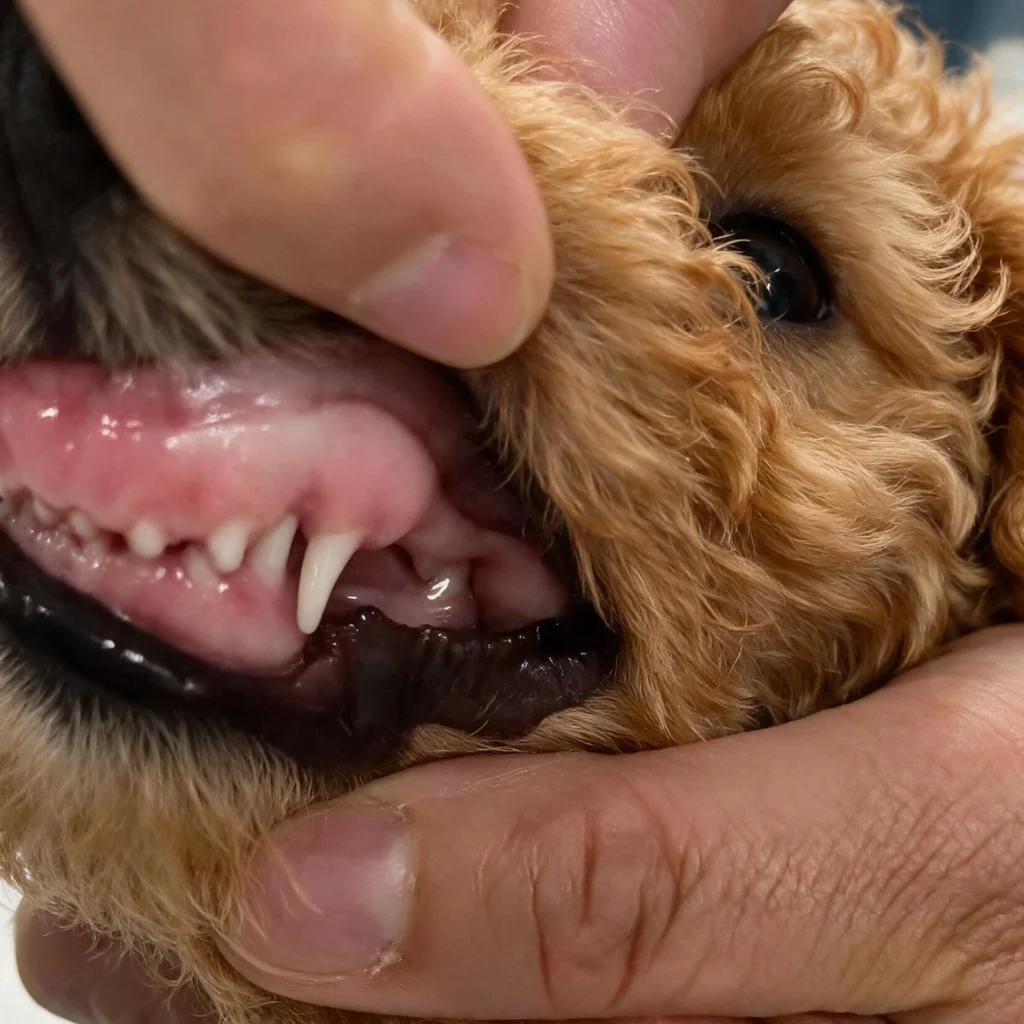
This can occur in the deciduous teeth or the permanent teeth. It may be associated with tooth position, jaw conformation or a discrepancy in the relative lengths of the upper and lower jaws.
Not every puppy with an unusual-looking bite has a clinically significant problem. The important distinction is whether the teeth are causing traumatic contact or preventing comfortable closure of the mouth.
For a more detailed explanation of the condition and available treatments, see our article on base narrow canines (linguoverted canine teeth).
Can abnormal canine teeth hurt if the puppy seems fine?
Yes. One of the difficulties with dental problems in dogs is that outward behaviour isn’t always a reliable indication of oral comfort.
When a lower canine tooth contacts the hard palate, it may produce a small indentation initially. With continued contact, this can progress to inflammation, ulceration or a penetrating wound.
A puppy may continue eating normally despite this.
Dogs don’t necessarily stop eating because something in their mouth hurts. They may chew differently, avoid particular textures or show no noticeable changes at all.
This is why examining the relationship between the teeth and the opposing tissues is so important. Looking only at the visible crowns, without checking where they contact when the mouth closes, can miss clinically significant abnormalities.
Persistent traumatic contact should not be dismissed simply because the puppy appears comfortable.
When should owners arrange a dental examination?
Most teething changes can be assessed during routine puppy health examinations, but some findings deserve earlier attention.
What you notice | What to do |
|---|---|
Increased chewing and baby teeth naturally loosening | Usually normal; discuss at routine puppy checks |
Permanent canine erupting beside a retained baby canine | Arrange a veterinary dental assessment |
Lower canine appearing to point towards the tongue or palate | Arrange an assessment to check the bite |
Tooth pressing into the palate, indentation or ulceration | Prompt veterinary assessment |
Bleeding, a puncture wound, obvious oral pain or difficulty eating | Seek veterinary attention promptly |
You don’t need to force your puppy’s mouth open to examine its teeth. If your puppy is comfortable having its lips gently lifted, you may be able to see whether there are two canine teeth together or whether the lower canine appears unusually positioned.
A proper assessment of the bite is best performed by a veterinarian. Some puppies require sedation or anaesthesia for a complete examination, particularly when the mouth is painful.
What treatments are available?
Treatment depends on the puppy’s age, which teeth are involved, the relationship between the jaws and whether there is traumatic contact.
Monitoring
Some minor variations in tooth position can be monitored when there is no traumatic contact and the veterinarian considers normal development likely.
Monitoring should involve a clear reassessment plan rather than simply waiting indefinitely.
Extraction of deciduous canine teeth
When a deciduous canine is retained or causing traumatic contact, extraction may be recommended.
In selected puppies with abnormal deciduous canine positioning, early extraction can relieve trauma and may allow more favourable jaw development. However, it does not guarantee normal permanent tooth alignment.
Ball therapy and orthodontic treatment
For carefully selected cases involving permanent mandibular canine teeth, a veterinary dentist may recommend ball therapy using an appropriately sized and positioned rubber ball to encourage outward movement of the canine teeth.
This is not suitable for every dog. It depends on the nature of the malocclusion, the stage of dental development and whether the teeth are capable of moving into an appropriate position.
Ball therapy should only be undertaken following veterinary assessment and specific instructions.
Other treatments may include orthodontic appliances, crown height reduction with appropriate endodontic treatment, or extraction. The most suitable approach depends on the individual case and the owner’s circumstances.
The objective is a comfortable, functional mouth, not necessarily a cosmetically perfect bite.
Why timing matters
Dental development happens relatively quickly in puppies, and the available treatment options can change as the permanent teeth erupt and the jaws mature.
An abnormal deciduous canine may be identified during the first puppy vaccination visits. A retained tooth may become apparent several months later as the permanent canine erupts.
Both situations provide opportunities for early assessment.
One common assumption is that any dental problems can simply be dealt with when the puppy is desexed. Sometimes that timing is appropriate, but not always.
If a tooth is already contacting the palate or interfering with permanent tooth eruption, delaying assessment for several months may prolong discomfort or allow further changes in tooth position.
The sensible approach is to identify the problem, assess its significance and make a treatment plan based on the puppy’s development rather than an unrelated surgical schedule.
A final word on puppy teeth
Most puppies develop a normal, comfortable bite without intervention. But the transition from baby teeth to adult teeth is worth paying attention to, particularly between four and seven months of age.
If your puppy has two canine teeth growing together, lower canines pointing inwards, or teeth that appear to contact the roof of the mouth, it’s worth having them examined.
A veterinary dental assessment can establish whether the changes are part of normal development or something that needs attention.
Personalised Mobile Vet provides home veterinary consultations across Brisbane, Ipswich and surrounding service areas. Puppy dental development can be assessed as part of a routine health consultation, with referral for dental procedures or specialist care where needed.
You can find more information about our services at Personalised Mobile Vet.
References
The following sources support the clinical information above. The veterinary journal studies provide evidence for specific treatment approaches, while the Merck Veterinary Manual provides specialist-reviewed guidance on dental development and abnormalities.
1. Haggerty, K., Block, K. and Battig, J. (2021) ‘Orthodontic inclined plane application using a visible light cure acrylic material for treatment of linguoverted mandibular canine teeth’, Journal of Veterinary Dentistry, 38(2), pp. 99–104. https://doi.org/10.1177/08987564211026747.
PubMed
2. Herrmann, K. and Taney, K. (2022) ‘Assessment of extractions of deciduous mandibular canine teeth to correct linguoversion malocclusion in 17 dogs’, Journal of Veterinary Dentistry, 39(3), pp. 234–240. https://doi.org/10.1177/08987564221099133.
PubMed
3. Merck Veterinary Manual (2024) ‘Developmental abnormalities of the mouth and dentition in small animals’, reviewed by B.L. Mulherin. Available at: Merck Veterinary Manual (Accessed: 10 November 2026).
Merck Veterinary Manual
4. Merck Veterinary Manual (2025) ‘Dental development of dogs’, reviewed by S. Muylle. Available at: Dental Development of Dogs (Accessed: 10 November 2026).
Merck Veterinary Manual
5. Verhaert, L. (1999) ‘A removable orthodontic device for the treatment of lingually displaced mandibular canine teeth in young dogs’, Journal of Veterinary Dentistry, 16(2), pp. 69–75. https://doi.org/10.1177/089875649901600202.